Here at refinance.com.au we keep a close eye on home lending trends because they directly affect the equity position and repayment costs of our customers. When we noticed owner-occupier loan numbers falling two quarters in a row across the country, we wanted to understand what that pattern has meant historically for Australian property prices – and what it could mean for homeowners right now. So we looked into it, using ABS lending and price data going back to 2003.
Here is what the research found.
One fall away from a historic signal
New owner-occupier home loans fell 3.8% in one quarter and then a further 3.3% the next. That puts Australia one quarterly fall away from a signal that has preceded every national property price downturn since 2008. The signal is three consecutive quarterly falls in new owner-occupier home loan numbers. Lenders wrote about 6,000 fewer of these loans in the June quarter than six months earlier.
Buyer numbers turn before prices do. Prices were still within 1% of their March quarter record in June, but the number of new owner-occupier loans had already been falling for two quarters running.
NSW and Victoria lead the decline
Owner-occupier loan numbers have now fallen two quarters running in four states. The falls since the December quarter 2025 are:
- NSW: 9.6%
- Victoria: 8.7%
- Queensland: 6.3%
- Western Australia: 4.9%
Four signals, four price downturns
The same signal – three consecutive quarterly falls in new owner-occupier loans – fired in 2008, 2010, 2018 and late 2021. Each time, national prices were at or within six months of their peak. In those four cycles, prices fell between 4.3% and 8.7%, with the low arriving nine to twenty-one months after the signal. A fifth signal in 2004 landed in the same quarter as that cycle’s trough. In 23 years of data, the signal has never been a false alarm.
Rates are rising as the signal approaches
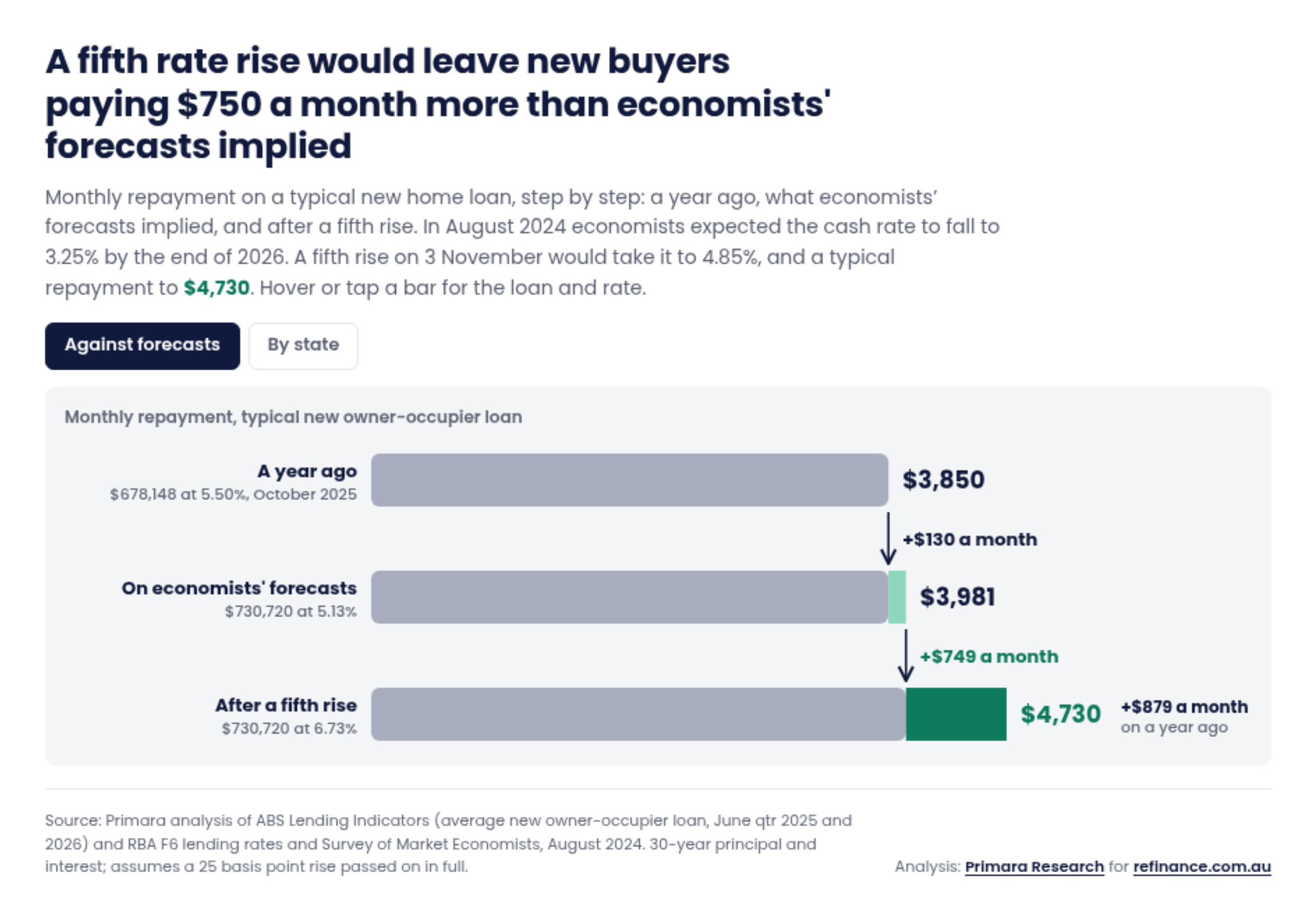
The RBA has raised the cash rate five times since February, bringing it to 4.85% on 3 November. APRA also began limiting high debt-to-income lending in February, and lending has fallen in both quarters of data since. In 2010, the Reserve Bank was raising rates at precisely the moment this signal fired. Prices peaked the following quarter and then fell for a year and a half. The conditions today are similar.
What a third fall would mean for prices
Prices have already slipped from their March quarter record. If the September quarter figures – due on 11 November – show a third consecutive fall, that record would likely mark this cycle’s peak, based on past form. The low would then be expected somewhere between mid-2027 and mid-2028. In the last cycle, prices bottomed nine months after the signal fired, which would point to the June quarter of 2027. Falls on the scale of previous cycles would take between $48,000 and $96,000 off the March quarter mean price.
For homeowners, this combination of factors – falling buyer numbers, rising rates and prices already off their peak – points to a softer market ahead, not a stronger one. That matters most for owners facing higher repayments at the same time as values may be declining.
A lower interest rate does the most work precisely in this environment. Securing a better rate now can reduce the pressure on household budgets and protect the equity position our customers have built, whatever the market does next.
Speak to one of our brokers about your refinancing options before the September quarter figures land.
About the data
This analysis uses publicly available data from the ABS Lending Indicators series – specifically new owner-occupier loan commitments (number, seasonally adjusted, excluding refinancing) – covering the March quarter 2003 to the June quarter 2026, released 14 August 2026. Property price data is drawn from the ABS Residential Property Price Indexes to the December quarter 2021, and the ABS Total Value of Dwellings mean price from the March quarter 2022 onward. RBA cash rate target history was also used. Price peaks and troughs are dated using the Harding-Pagan (Bry-Boschan) rule.