Here at refinance.com.au we have been watching how lenders handle money that borrowers have paid ahead on their home loans, because the rules around this can hit household budgets just as hard as the interest rate itself. When a loan moves between lenders – whether the borrower chooses to refinance or a lender acquires another bank’s book – those rules can change overnight. We wanted to understand exactly how much exposure Australian homeowners have, so we looked into it. Here is what our research found.
$275 billion sitting in redraw accounts
As of June 2026, up to $275 billion sits in Australian home loan redraw accounts. That is a significant pool of money that borrowers have paid ahead on their mortgages and can, in theory, draw back down. But the way a lender treats that balance when setting minimum repayments can determine whether that buffer works for a household or against it.
Offset accounts hold even more – $340 billion, representing 13.7 per cent of total housing loan balances. Yet no lender we checked confirms that an offset balance lowers the minimum repayment.
The repayment swing that catches borrowers out
Consider a borrower who owes $250,000 on their home loan and has paid $150,000 ahead. At 6.45 per cent with 25 years remaining, different lenders handle this very differently:
- One lender sets the minimum repayment on the $250,000 actually owed – that is $1,680 a month.
- Another sets it as though the full $400,000 were still outstanding – that is $2,688 a month.
That is a difference of $1,008 a month from the same underlying loan, simply because of how the two lenders calculate the minimum. The borrower has not taken on more debt. The rate has not moved. Only the rule has changed.
How the lenders we checked stack up
We checked the websites of 28 lenders and brands to find out how they set minimum repayments when a borrower is ahead. Of the 17 that publish a clear rule:
- 1 lender lowers the minimum automatically and lets the borrower keep their redraw balance.
- 3 lenders lower it only if the borrower asks, and let them keep their redraw.
- 9 lenders lower it only if the borrower gives up access to their redraw.
- 2 lenders never lower the minimum, regardless of the redraw balance.
The majority of lenders have structured their rules so that borrowers must choose between keeping their redraw buffer and getting a lower minimum repayment. For most people, that is not really a choice – it is a forced outcome.
Every $10,000 in redraw adds to the risk
Only loans with money in redraw are exposed to this issue. But for those borrowers, the stakes scale up quickly. At 6.45 per cent, every $10,000 sitting in redraw can lift the minimum monthly repayment by approximately:
- $67 a month with 25 years remaining on the loan
- $113 a month with 10 years remaining
- $195 a month with 5 years remaining
The closer a borrower is to paying off their loan, the sharper the potential impact on their monthly budget.
Refinancing does not rescue the redraw balance
A common assumption is that refinancing solves the problem. It does not – at least not automatically. When a loan is refinanced, the new lender pays out only what is owed on the original loan. The redraw balance does not transfer across. The borrower either loses access to those funds or borrows them back, and it is the new lender’s repayment rules that then apply.
This means the minimum repayment rule can affect a household’s budget as much as the interest rate. Anyone carrying a large redraw balance needs to understand how a new lender calculates minimum repayments before they commit to switching.
For our customers, this research is a reminder that refinancing is about more than the rate on the label. If you have been diligently paying ahead on your home loan, that buffer is worth protecting – and the lender’s repayment calculation methodology is now a key part of the decision, sitting alongside rate, fees, and loan features.
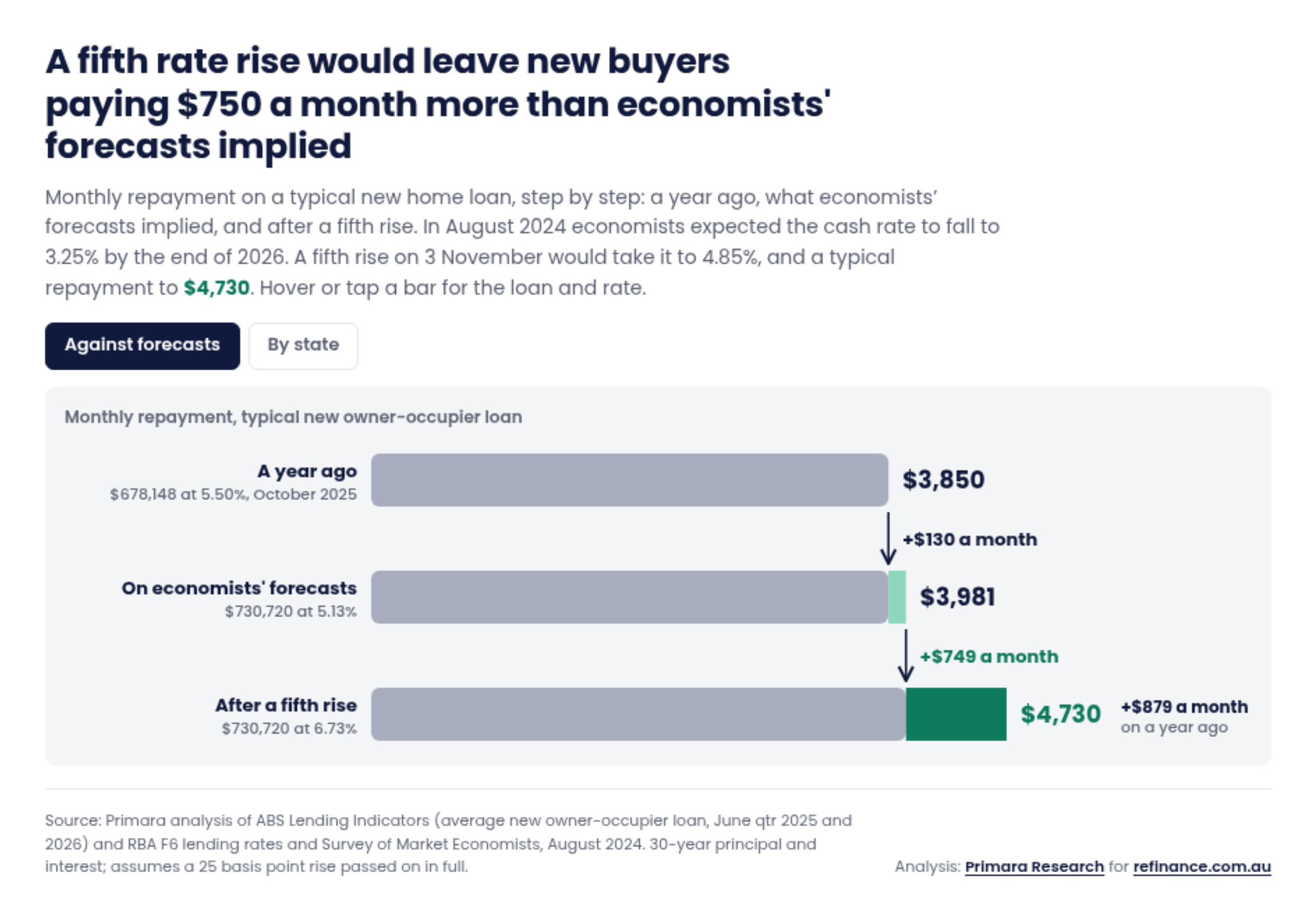
With the cash rate at 4.6 per cent after four rate rises this year, monthly cash flow matters more than ever. Understanding what will happen to your minimum repayment before you switch is not a detail – it is central to whether the move actually improves your position.
Speak to one of our brokers to understand how your redraw balance could be affected before you refinance.
About the data
This analysis uses APRA Quarterly Property Exposures data for June 2026 and a review of the websites of 28 lenders and brands, checked on 22 and 26 October 2026. Repayment examples are calculated at 6.45 per cent.